From the MTASA (Massage Therapy Association of South Africa) Conference 03 June 2023, lecture notes taken by Roxanne, from the lecture by Jacqui McCord Uys – Sports Physiotherapist.
With any injury it is important to focus on the treating of the whole person, why treat as a unit?
- Fascia is the spring in your body – transferring energy through one area to another
- Stability and mobility are inter-independent in our bodies
- If the chain is locked and tight higher up in the body, the movement below is compromised.
- Our bodies also work with opposite sides helping to stabilise (kinetic chains)
- Chronic injuries are never sorted with spot treatment
- Massaging and stretching are imperative to cascade healing
Anterior knee pain:
Can be cause by: fat pad impingement, bursitis, patellar tendonitis. Bursitis and Baker’s cyst can occur around the knee. Iliotibial band syndrome and popliteal spasm can also cause knee pain.
Running and shoes:
Always check if your shoes are still okay. Old shoes can be one of the biggest causes of knee pain. Things to check with knee pain (specific to a runner):
- When do you get pain? – Before activity, i.e. in the morning when you get out of bed / when you climb out of your car or stand up from the chair / at the start of your run / gradual onset during the run / after the run?
- How does the pain present itself? – Sharp / dull gradually getting stronger / stiffness / hotness?
- Check with palpation – swelling / tightness / check patellar movement.
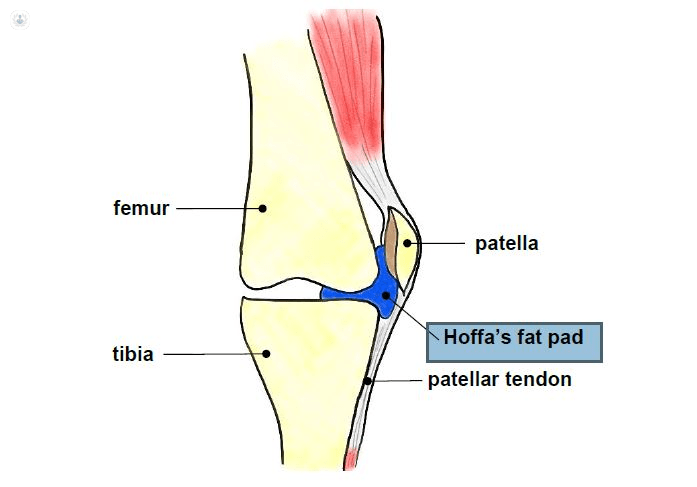
What is Fat Pad Impingement? (Known as Hoffa’s Syndrome):
The client will feel the following: pain, a burning or aching sensation, deep to patellar tendon and medial and lateral to tendon. On palpation there is tenderness and discomfort close to the inferior pole of the patellar. The client is limited in full extension and limited flexion of the knee joint. Non-operative management: taping and exercises to contribute to correcting the biomechanics. Massage can contribute by focussing on quads, hip flexors and gluts to assist in correcting, loosening and strengthening the biomechanics to take pressure off of the knee.
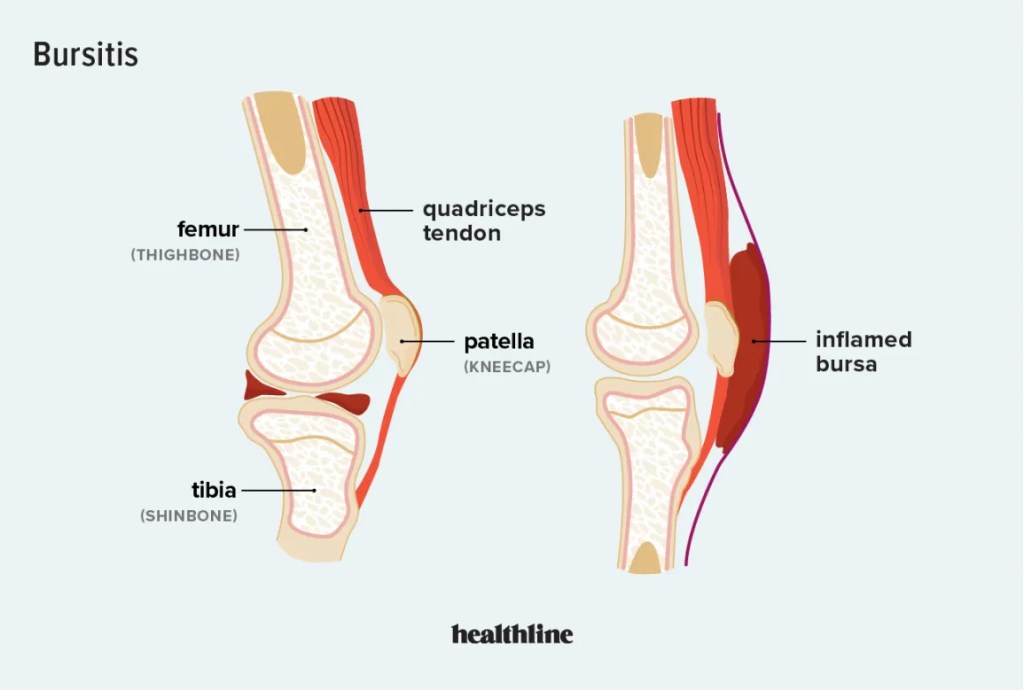
What is Bursitis? (Known as Housewife’s or Carpenter’s knee):
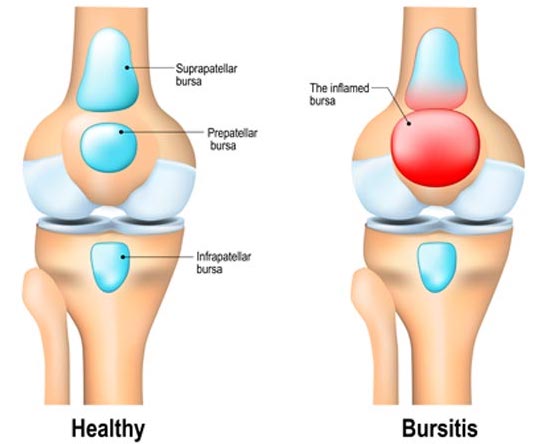
There is a bursae just below the kneecap. The bursae are fluid filled sacs which protect the kneecap against friction and assist with shock absorption can get inflamed and fill with excessive fluid – when there is too much friction caused (like a giant blister). There is pain in the front of the knee below the patellar with localised swelling. Treatment includes: taping, aspiration or corticosteroid injection may be needed, cryotherapy (cold therapy) to reduce pain and swelling, rest and modify activities (no kneeling) and massage – do not massaged on the area directly, but rather above and below to release tension.
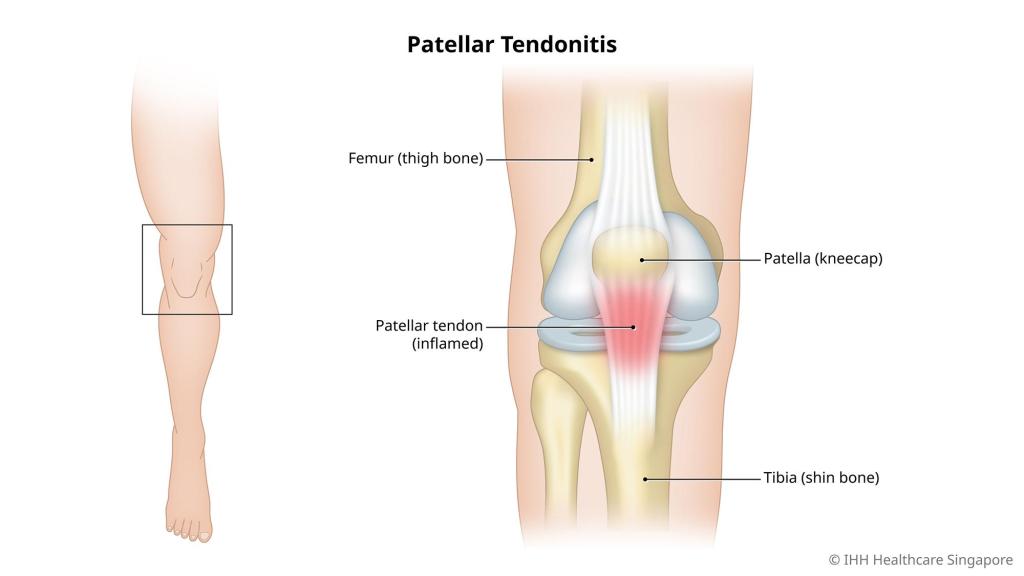
What is Patellar Tendonitis? (Known as Jumper’s Knee):
This is the inflammation of the patellar tendon that can weaken and tear if not treated. It is an overuse injury with weak and stiff muscles contributing. Symptoms include: pain on patella edge and down the tendon, swelling and pain with knee movement and jumping. Treatment includes: change training and work in pain free range of movement, decline exercises, taping, physiotherapy for accelerated healing and massage to release all the tight muscles esp. the quadriceps, which reduces tension on the tendons.
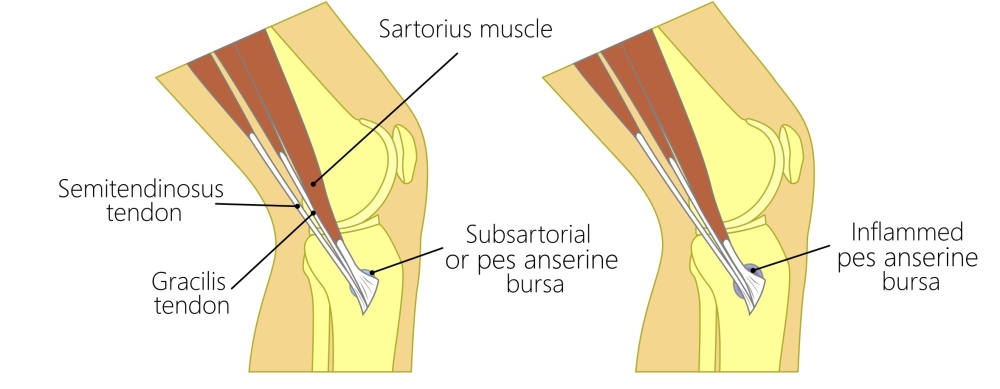
What is Goose foot bursitis? – Pes Anserine Bursitis:
Affecting the inside lower part of the knee. This is inflammation of bursa located between the shinbone (tibia) and 3 tendons that insert in a duck foot shape. Muscles to focus on: hamstring – semitendinosus, adductor – gracilis, kicking muscle – sartorius. Symptoms include: pain and swelling inside of the knee about 3 fingers below the joint line, puffiness and tenderness can be felt in the area. This is caused by training changes such as increased hill training, increased mileage and softer uneven terrain, collapsed shoes, tight leg muscles, obesity, excessive internal rotation and knee osteoarthritis. Treatment: rest, modify training program, correct biomechanics, check shoes and orthotics, massage to release tension on all surrounding muscles esp. the muscle of the 3 tendons.
What is Bursitis of the Knee? (Also known as Hot Knee) / Supra Patellar Bursitis:
This affects the bursae above and under the patellar (superior), in most cases its part of the knee joint, diagnosis is important to differentiate between a septic and non-septic bursitis / knee. This can be caused by trauma or overuse. Signs include: swelling, hot knee, pain in the knee and limited range of movement. Treatment includes: rest, ice, compression or drainage taping and lymph drainage massage.
What is Baker’s Cyst / Popliteal Cyst?:
This is a fluid filled sac behind the knee causing a bulge. The main cause is due to knee trauma (arthritis / cartilage tear) and this causes an increase in the fluid. Symptoms: pain behind the knee, swelling or tight feeling, limited range of movement and a sharp pain with certain movements. Always be cautious !Pain in the calf and swelling can cause a deep vein thrombosis (DVT) / blood clot! The treatment: always be cleared by a healthcare practitioner that there is no DVT before massaging. Rest and elevation, drainage taping and massage to release calf and hamstring tightness can assist this.

What is Iliotibial Band Syndrome?:
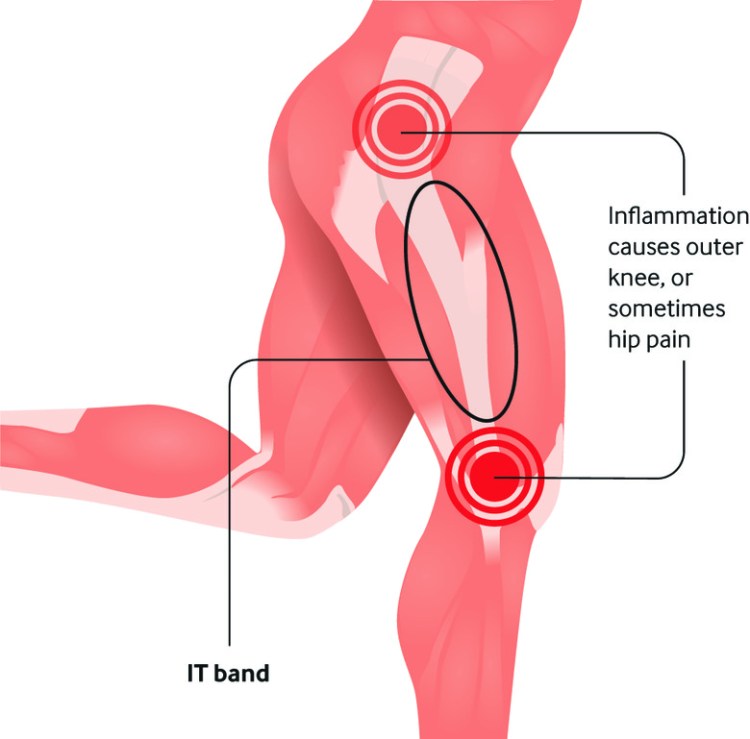
This is a friction syndrome, and too much too soon is the main cause. Incorrect shoes can also contribute to this disorder. Symptoms include an aching, burning feeling on the outside of the knee, which is aggravated by exercise and is worse with downhill running or stairs. The treatment is to advise to slow down, have your shoes checked and stop running when there is pain. Massage assists by releasing tight muscles along the full fascial line – posterior and lateral muscles and ITB.
Pearls for runners and knee problems – check your shoes / check psoas tightness – flexion position in day-to-day work is detrimental to psoas and in turn the ITB / gluteal tightness / gluteal medius weakness / tight lateral line / upper body thoracic and shoulder tightness.
The Gluteus Medius can cause many problems when it is weak: it is important in walking/running to stabilise pelvis in stance phase. It can cause problems such as: lower back pain into hip / ITB / shin splints / plantar fasciitis and posterior knee pain.
The Psoas muscles are required for hip flexion, which is often shortened due to posture in training and working conditions. Knots usually found just off the belly button.
Summary: look at the injured athlete as a unit and not an injury, release above and below the injury, the focus on the injury, taping and massaging, remind patients of the value of stretching and exercise.
For more information, enquiries or to book an appointment, WhatsApp Roxanne on 079 567 5090 or easily book your appointment on Booksy.
 Therapeutic Massage by Roxanne